

If you’re a Nigerian living abroad and wondering whether now is still a good time to buy land in Abuja, the honest answer is: it depends entirely on where you buy — and the data on price growth across the Federal Capital Territory (FCT) makes that clearer than ever. Some districts have quietly become gold mines for early investors, while others have plateaued.
This article breaks down what’s actually happening with land values across Abuja right now, why it matters for diaspora buyers specifically, and how to position yourself ahead of the next wave of appreciation — with the guidance of a trusted realtor and property advisor on the ground: ASIWAJU OF ABUJA REAL ESTATE (call/WhatsApp 08148337425).
Why Land Appreciation Data Matters More for Diaspora Investors
When you live outside Nigeria, you don’t have the luxury of driving past a plot every weekend to see how the neighborhood is developing.
You’re relying on numbers, trends, and the word of people you trust. That’s exactly why understanding appreciation patterns — not just current prices — is the single most valuable thing a diaspora investor can learn before wiring money home.
Land in Abuja doesn’t appreciate uniformly. A plot in a mature, fully built-up district might hold its value but grow slowly, while a plot in a district on the edge of new infrastructure can double in value within a few years. Knowing the difference is what separates diaspora investors who build generational wealth from those who simply “own land” with no real growth to show for it.
Current Snapshot: What Land Costs Across Abuja Right Now
As of 2026, land prices across the FCT vary dramatically by district — from roughly ₦50,000 per square meter in developing areas to over ₦600,000 per square meter in prime, fully serviced districts. That range itself tells the story: the earlier you buy into a growth corridor before it matures, the more room there is for your investment to climb.
Prime, established districts (Maitama, Asokoro, Wuse II)
These areas remain the gold standard for prestige and stability. Prices here are already high, and appreciation tends to be steady rather than explosive — you’re paying for paved roads, drainage, security, and diplomatic-grade infrastructure that’s already in place. Better suited to investors prioritizing wealth preservation and rental income than rapid capital growth.
The infrastructure frontier (Jabi, Utako, Katampe)
This is where some of the fastest land appreciation in the FCT is currently happening. As new road interchanges and utility extensions connect these districts to the city core, land values here have in some cases climbed 30–40% within a single year.
For diaspora investors, this middle zone — no longer “raw” land, not yet fully built-up — often represents the sweet spot between affordability and growth potential.
Satellite towns and affordability hubs (Lugbe, Kubwa, Bwari, Gwagwalada)
These are the entry points for investors working with smaller budgets. Plots in areas like Bwari’s Ushafa layouts can be found from roughly ₦1.2 million to ₦12 million, while Kubwa ranges from about ₦3 million to ₦20 million depending on proximity to major roads. Ongoing road expansion projects connecting these satellite towns to central Abuja are steadily “unlocking” them — meaning today’s affordable plot could be tomorrow’s premium address.
The pattern across all three zones is consistent: infrastructure precedes appreciation. Wherever government or private developers extend roads, drainage, and electricity, land value follows — often within 24 to 36 months.
Five Signals That Predict Land Appreciation in Abuja
- Proximity to a newly graded or asphalted road. A plot on a rough gravel access road can see its value jump significantly the moment contractors pave it.
- Government allocation activity. Districts where the FCT Administration is actively releasing land for Phase 3 and Phase 4 expansion offer early-mover advantages.
- Nearby institutional anchors. Universities, teaching hospitals, and government agencies create sustained demand that supports steady growth.
- Distance-decay adjusted for road access. A plot 25 minutes from the city via a new expressway can outperform a plot that’s technically closer but poorly connected.
- Titled land with a clear Certificate of Occupancy (C of O) or FCDA allocation. Untitled land may look cheap, but buyers pay a premium for verified title — and that premium grows over time.
Why Naira Depreciation Actually Works in Your Favor
Currency dynamics between the Naira and currencies like the US Dollar, British Pound, or Canadian Dollar mean money earned abroad often stretches further when converted for a Naira-denominated purchase like land.
While property prices in Naira terms continue to rise, the dollar-equivalent cost of Abuja land has, at various points, remained attractive compared to real estate in Lagos, London, or North American cities. Land is a hard asset that tends to hold or grow its Naira value over time — a hedge cash savings alone can’t offer.
Land Banking: The Diaspora Investor’s Advantage
Most successful diaspora land investors in Abuja aren’t building immediately — they’re land banking: buying titled land in a growth corridor and holding it for three to ten years while infrastructure catches up and value compounds.
This suits diaspora buyers well because you don’t need to manage construction or tenants from abroad, your capital is preserved in a physical asset rather than a depreciating currency, and you retain full flexibility to build, sell, or pass the asset to your children later.
The Risk Diaspora Investors Can’t Ignore
None of this appreciation potential matters if the land itself is compromised — disputed title, government acquisition, omo-onile conflicts, or an agent without real authority to sell.
This is exactly why diaspora buyers shouldn’t purchase land based on photos and promises alone. You need someone on the ground who can verify title at AGIS, confirm the seller’s authority, and represent your interests as if you were standing there yourself.
Why Work With ASIWAJU OF ABUJA REAL ESTATE
For diaspora Nigerians who want to benefit from Abuja’s appreciation trends without the fear of fraud or wrong location decisions, ASIWAJU OF ABUJA REAL ESTATE offers:
- Verified, titled land across growth corridors in Abuja and its satellite towns.
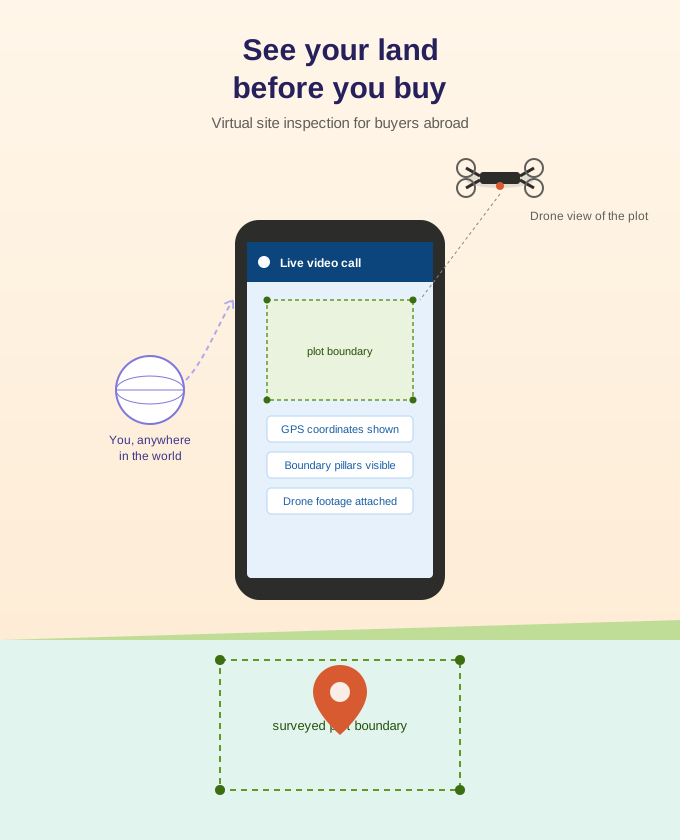
- Remote-friendly transactions — document verification, virtual site updates, transparent payment plans.
- Local market intelligence on which districts are entering their appreciation phase.
- End-to-end guidance from site selection through title perfection and post-purchase land security.
Ready to turn Abuja’s land appreciation trends into your own investment story? 📞 Call or WhatsApp ASIWAJU OF ABUJA REAL ESTATE today: 08148337425
Whether you’re working with ₦2 million or ₦50 million, there’s a verified plot and a growth corridor to match your budget and timeline.
Disclaimer: Real estate values can rise or fall based on market, government, and economic conditions. Past appreciation is not a guarantee of future performance. Always verify land documentation independently before purchase.