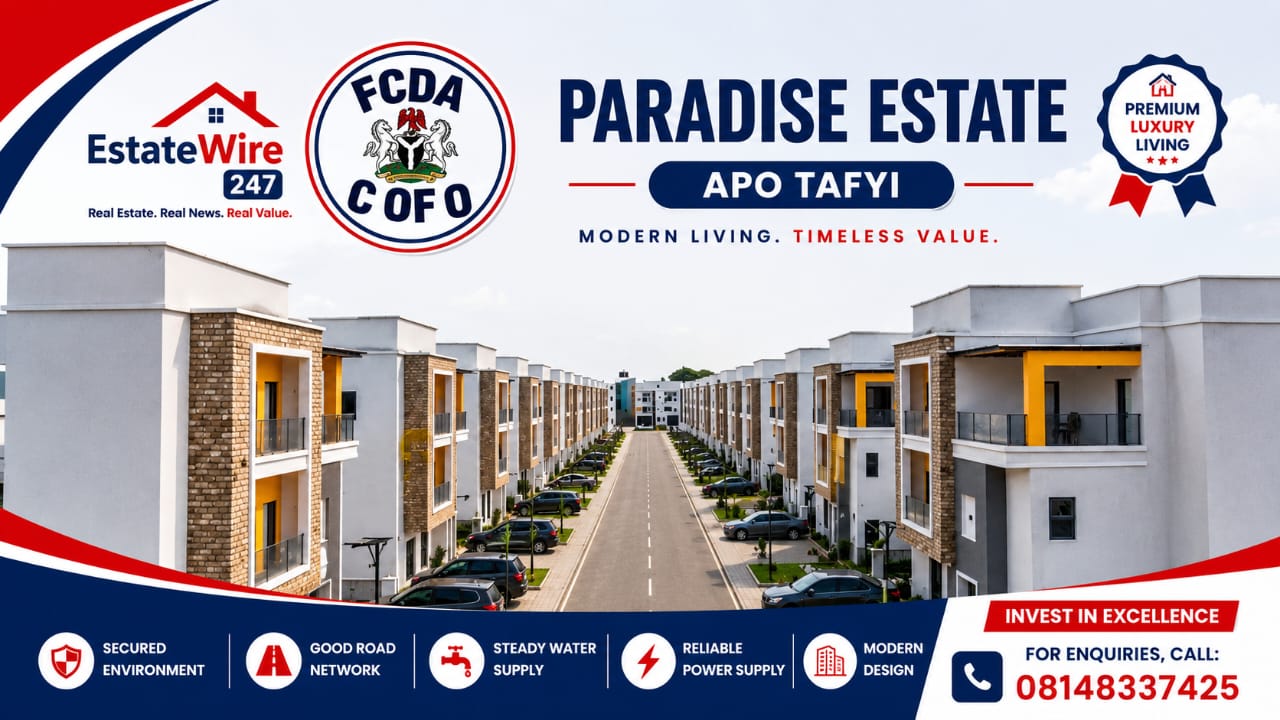


Abuja’s residential property market is shaped by government activity, diplomatic presence, and planned urban development. Compared to Lagos, Abuja offers larger plot sizes and more structured zoning, but prices remain elevated in central districts where land supply is constrained.
This page provides an overview of current residential property prices in Abuja, covering houses, apartments, and land across major neighbourhoods.
House Prices in Abuja
Residential property prices in Abuja are expected to remain firm in prime districts, with gradual appreciation in emerging locations as infrastructure improves.
Scroll horizontally to view full table →
| Area | Property Type | Unit | Avg Price | Min | Max | ₦ / sqm | Demand | Trend | Notes |
|---|---|---|---|---|---|---|---|---|---|
| Maitama | Detached House | 5-bed | ₦1.2bn | ₦750m | ₦3.5bn | ₦1.2m–₦1.6m | High | Increasing | Prime diplomatic district; low supply, high HNI demand. |
| Maitama | Apartment | 3-bed | ₦650m | ₦350m | ₦1.2bn | ₦1.0m–₦1.3m | High | Increasing | New luxury apartments driving upward pricing. |
| Asokoro | Detached House | 5-bed | ₦950m | ₦600m | ₦2.5bn | ₦950k–₦1.3m | High | Stable | Political and security enclave; limited new stock. |
| Asokoro | Apartment | 3-bed | ₦480m | ₦280m | ₦900m | ₦850k–₦1.1m | Medium-High | Stable | Older homes dominate; selective luxury infill. |
| Wuse II | Apartment | 3-bed | ₦420m | ₦220m | ₦750m | ₦750k–₦1.0m | High | Increasing | Strong rental-to-sale conversion demand. |
| Wuse II | Terraced Duplex | 4-bed | ₦550m | ₦350m | ₦1.0bn | ₦850k–₦1.1m | High | Increasing | Popular with professionals and expatriates. |
| Gwarinpa | Detached Duplex | 4-bed | ₦320m | ₦180m | ₦650m | ₦450k–₦650k | High | Increasing | Largest estate in Abuja; family-driven demand. |
| Gwarinpa | Apartment | 3-bed | ₦180m | ₦90m | ₦350m | ₦350k–₦500k | High | Increasing | Affordable relative to city core. |
| Jabi | Apartment | 3-bed | ₦380m | ₦200m | ₦750m | ₦700k–₦950k | High | Increasing | Lake proximity and retail hubs boosting values. |
| Utako | Apartment | 2-bed | ₦220m | ₦120m | ₦420m | ₦500k–₦700k | Medium-High | Stable | Central location; aging stock moderates pricing. |
| Kubwa | Detached House | 4-bed | ₦180m | ₦90m | ₦380m | ₦280k–₦420k | High | Increasing | Major affordability hub for Abuja workforce. |
| Kubwa | Apartment | 2-bed | ₦95m | ₦45m | ₦180m | ₦220k–₦350k | High | Increasing | Strong first-time buyer demand. |
| Lokogoma | Terraced Duplex | 4-bed | ₦260m | ₦150m | ₦520m | ₦350k–₦550k | High | Increasing | Rapid development corridor. |
| Lugbe | Apartment | 2-bed | ₦75m | ₦35m | ₦150m | ₦200k–₦300k | High | Increasing | Entry-level market with strong population inflow. |
Abuja Land Titles: FCDA, AGIS, and C of O Explained
Buying property in Abuja is unique because the Federal Government (through the FCT Minister) technically owns all the land. To ensure your investment is secure, you must understand the “Zoning” and “Title” hierarchy.
The Gold Standard: Certificate of Occupancy (C of O)
The C of O is the highest level of land ownership in Abuja. It is a 99-year statutory lease issued by the FCT Minister.
- Why it matters: It is the only title 100% recognized by banks as collateral and offers the strongest protection against government revocation or demolition.
The Preliminary Step: Right of Occupancy (R of O)
Many new allocations in developing districts (like Lugbe or Lokogoma) come with an R of O.
- The Catch: This is essentially a “promise” of land. To be fully secure, you should eventually “recertify” this at AGIS to upgrade it to a full C of O.
Zoning: The Silent Price Driver
Abuja is a strictly planned city. Every plot is zoned for a specific purpose: Residential, Commercial, or Mixed-Use.
- The Risk: If you buy a “Residential” plot in Wuse II and try to build a shopping mall, the FCDA can (and will) demolish it.
The Infrastructure Factor: Why Abuja is Divided into Phases
Abuja’s property market is built on a systematic “Master Plan” divided into phases. Understanding these phases is the secret to predicting where property values will jump next. In Abuja, infrastructure leads, and price follows.
Phase 1: The Premium Core (Maitama, Asokoro, Wuse II)
Phase 1 districts enjoy 80–90% infrastructure completion. You are paying for paved dual carriage roads, underground drainage, and a more stable power grid.
- SEO Insight: Prices here are stable but high. Investors buy here for wealth preservation and diplomatic rental yields.
Phase 2: The Infrastructure Frontier (Jabi, Utako, Katampe)
This is where the most rapid appreciation is happening in 2026. As the government completes new interchanges (like the N16 connecting Maitama and Katampe), land prices in these areas often jump by 30–40% in a single year.
- Why it matters: Jabi and Katampe offer Phase 1 luxury but with “Phase 2” growth potential.
Phase 3 & Satellite Towns: The Affordability Hubs (Lugbe, Kubwa, Karmo)
Infrastructure here is still developing, which is why entry prices are lower.
- The “Wike Effect”: Significant road expansions in satellite towns (like the Apo-Wassa road) are currently “unlocking” these districts. Buying in Lugbe now is a bet on the 150km of new roads currently being laid across the FCT.
Pro Tip for Investors: Don’t just look at the house; look at the access road. A property on a graded gravel road will double in value the moment the FCDA pours asphalt on that street.
Abuja vs. Lagos: Which Market Wins in 2026?
Choosing between Nigeria’s two biggest real estate markets depends entirely on your investment goals. While Lagos offers the highest “ceilings” for profit, Abuja provides a level of structural stability that is rare in West Africa.
The Rental Yield Battle
- Lagos: The “Cash Flow” King. Due to the massive housing deficit and the boom in Short-let apartments (VI, Lekki, Ikeja), Lagos offers superior rental yields, often reaching 6–10% for standard leases and up to 25% for well-managed short-lets.
- Abuja: The “Reliable” Income. Abuja’s rental market is driven by the “Monday-to-Friday” crowd—politicians, diplomats, and NGO workers. While yields are slightly lower (5–8%), the tenants are often high-net-worth or corporate-backed, leading to fewer defaults and longer tenancies.
Capital Appreciation & Growth
- Lagos: Lagos is a “speculative” market. Infrastructure projects like the Lekki Deep Sea Port or the Fourth Mainland Bridge can cause land prices in areas like Epe to jump by 100% in a year. It is high-risk, high-reward.
- Abuja: Abuja is a “steady” market. Property values in Phase 1 and 2 districts appreciate at a consistent 8–12% annually. It is the preferred choice for “Land Banking” because the master plan makes it easier to predict which areas will stay premium for decades.
The “Stress” Factor
- Lagos: Investors must deal with “Omonile” (land grabber) issues, higher construction costs due to swampy terrain (piling), and the constant threat of coastal flooding.
- Abuja: Abuja is significantly more “investor-friendly.” The terrain is solid (no expensive piling needed), the city is cleaner, and the AGIS digital land registry makes due diligence much faster and more transparent than in Lagos.
The 2026 Verdict: Invest in Lagos if you want aggressive growth and high-turnover rental income. Invest in Abuja if you want a low-maintenance, secure asset that acts as a “hedge” against economic volatility.
Abuja Property Price FAQs
How much does it cost to buy property in Abuja?
Property prices in Abuja vary widely by location and property type. Entry-level homes are available in emerging districts, while prime areas command significantly higher prices.
What is the average house price in Abuja?
Average house prices range from hundreds of millions of naira in central districts to lower levels in suburban areas, depending on plot size and finishing quality.
Which areas are the most expensive to buy property in Abuja?
Maitama, Asokoro, and parts of Wuse II are among the most expensive residential areas in Abuja due to limited land supply and strong demand.
Which areas are more affordable to buy property in Abuja?
More affordable options can be found in areas such as Lugbe, Lokogoma, Kubwa, and parts of Gwarinpa.
Are property prices rising in Abuja?
Yes, property prices in Abuja are rising gradually, particularly in central districts with constrained land supply.
Is Abuja cheaper than Lagos for property buyers?
In general, Abuja property prices are lower than Lagos in comparable segments, although prime locations in both cities command premium pricing.
What affects property prices in Abuja?
Key factors include location, plot size, land title, infrastructure quality, security, and proximity to government and commercial centres.
Is buying property in Abuja a good investment?
Abuja property can be attractive for long-term investors due to stable demand, planned development, and lower volatility compared to some markets.